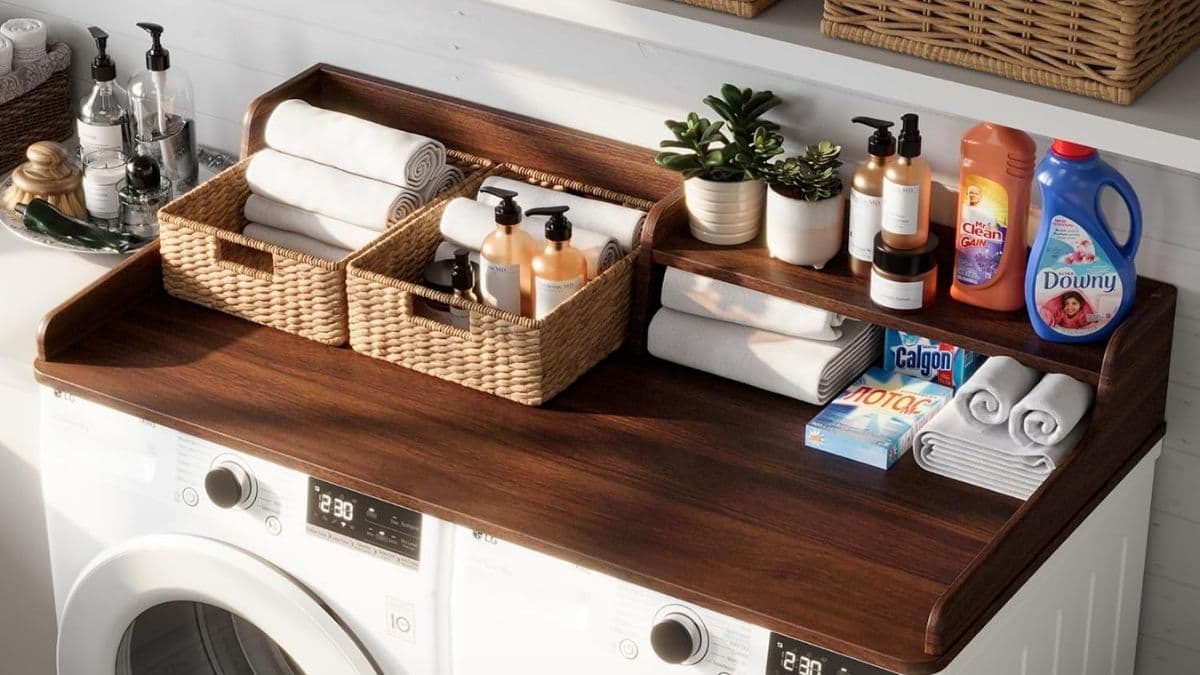
Laundry rooms often lack usable workspace. The area above front-load machines is usually empty or underutilized.
A washer dryer countertop solves this by creating a flat, stable surface. It turns that unused space into a functional station for folding, sorting, and organizing.
This simple addition can change how you handle daily laundry tasks.
What a Washer Dryer Countertop Offers
A washer dryer countertop is designed to sit securely across paired machines. It creates a bridge-like surface without requiring permanent installation.
Most models share similar specs:
- Around 54 inches wide and 27 inches deep
- Built from engineered wood, MDF, or bamboo - Designed for standard front-load washer and dryer setups
This universal sizing allows easy integration into most laundry rooms.
Key Features That Make It Practical
These countertops focus on usability rather than complex design. Each feature supports daily convenience and durability.
Universal Fit Design
- Fits most front-load washer and dryer combinations
- Eliminates the need for custom measurements
- Works well in apartments or standard homes
Durable Material Construction
- Made from P2 CARB particle board, MDF, or bamboo
- Thickness ranges around 0.6 inches
- Built to handle regular use without warping
Protective Surface Finish
- Heat-resistant coating
- Water-resistant laminate
- Easy to clean with a quick wipe
Anti-Slip Stability System
- Includes non-slip pads
- Reduces movement during machine vibration
- Keeps the countertop stable during spin cycles
Edge Guards for Safety
- Raised edges (2–2.75 inches high)
- Prevent items from sliding off
- Useful when folding or stacking clothes
Strong Load Capacity
- Supports up to 250 pounds
- Handles laundry baskets, detergents, and folded clothes
These features work together to create a reliable and low-maintenance surface.
Real-World Use and Performance
In daily use, the biggest advantage is convenience. You no longer need to carry laundry to another room for folding.
The added surface allows you to:
- Fold clothes immediately after drying
- Sort laundry into piles
- Store detergents and supplies within reach
The stability is also noticeable. With proper placement, the countertop stays steady even during heavy washer cycles.
This makes it suitable for households with frequent laundry loads.
Installation and Setup
Setup is simple and does not require professional help. Most models include pre-drilled holes and basic hardware.
Typical installation steps:
- Place the countertop across both machines
- Attach or position anti-slip pads
- Align edges for balance
The entire process usually takes only a few minutes. This makes it a quick upgrade rather than a full renovation.
Advantages in Everyday Use
The main value comes from improved organization and workflow. Instead of working around your machines, you work on top of them.
Key benefits include:
- Maximizes unused vertical space
- Creates a dedicated folding area
- Keeps laundry supplies organized
- Reduces clutter in small rooms
- Costs less than custom cabinetry
It is a practical upgrade for users who want better function without major expense.
Limitations to Consider
While useful, this solution is not perfect. There are a few trade-offs to keep in mind.
- Universal sizing may not fit all machine models perfectly
- MDF versions may feel less premium than solid wood
- Slight shifting can occur if not properly aligned
- Does not match the look of built-in countertops
These are mostly minor issues, but they can matter depending on your setup.
Who This Works Best For
A washer dryer countertop is ideal for users who prioritize function over design. It fits well in spaces where efficiency matters more than aesthetics.
Best suited for:
- Homes with front-load washer and dryer units
- Small or compact laundry rooms
- Users who want a quick upgrade without renovation
- Households that handle frequent laundry loads
If your laundry space feels cramped or disorganized, this adds immediate structure.
Why It’s a Practical Upgrade
A washer dryer countertop is a simple addition with noticeable impact. It improves workflow without changing your appliances or layout.
You gain a stable workspace, better organization, and more efficient use of space.
While it may not replace custom cabinetry, it offers a strong balance between cost and functionality. For most households, that balance is exactly what makes it worth considering.